
Brain on Music Education 105: New Proof-Music Study Effects Multiple Brain Areas
Christopher Viereck, PhD, Neurobiologist in residence, Music Empowers Foundation
With last month’s successful MEF fundraiser behind us, it’s time for our fifth column. It is probably a good time to remind you of the key questions “Your Brain on Music Education” is addressing. You may recall when the series was introduced last summer that we were going to examine several questions:
- What is it about music education that helps the brain wire itself more effectively such that children perform better in many other ways?
- What does music education do to the 100 billion neurons and their 100 trillion connections? Are the changes of short or long duration?
- Are there parts of the brain that are more affected than others?
- What do those colorful brain scans we often see on television programs or in science updates mean?
Keep these questions as you read this month’s column. We will be focusing on very new research on differences in the brain wiring of musicians and non-musicians published in the prestigious journal, Proceedings of the National Academy of Sciences (PNAS) by a group at the Max Planck Institute (MPI) in Tuebingen, Germany. The Max Planck Institute is to Germany what MIT, Harvard and the like are to the US: World class research institutes. Appearing in the December, 2011 issue of PNAS, the findings of Drs. HweeLing Lee and Uta Noppeney shed light on all the questions above.
To understand the study, its implications and limitations, let’s break it up into smaller pieces.
What are the implications of the study? The co-activation of different brain regions in musicians (but much less so in non-musicians) in response to the stimulus described above strongly suggests that the musicians developed a distinct set of neuronal connections between different brain regions as a result of their musical training and regular practice. The new wiring is in areas of the brain known to be uniquely activated during regular musical training. But the previous research did not demonstrate the clear co-activation of the different brain regions in response to the stimulus that this brilliant study did.
Participants: There were 37 participants: 18 musicians and 19 non-musicians. The musicians were amateur pianists who began practicing before they were 12, had practiced for at least 6 years and at least 1 hour per week for the past 3 years. The non-musicians had never practiced piano and had less than 3 months of any musical training.
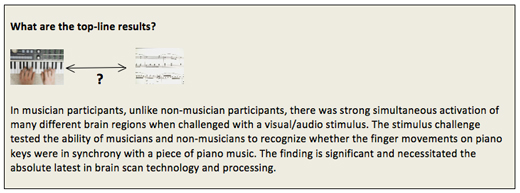
What were the results from arm 1 (film of finger movements on piano and separate audio track of piano music)? In musician participants, unlike non-musician participants, there was strong simultaneous activation of many different brain regions when challenged with a visual/audio stimulus: The left cerebellum, and several areas of the cerebral cortex: The left pre-motor cortex, right posterior superior temporal sulci/gyri. The locations of these areas are marked in the figure below. You may recall from the first “Brain on Music Education” column that these areas were thought to be “recruited” during music education. FYI, sulci (sulcus = singular form) and gyri (gyrus = singular form) refer to the bottoms and tops of brain folds, respectively. The surface of the brain is characterized by multitudinous folds.
What were the results from arm 2 (film of lip movements and separate audio track of spoken sentences)? While the same areas of the brain were activated as in the first arm, there were no differences between musicians and non-musicians. Some may have expected there to be a cross-benefit of piano instruction on the speech paradigm. In a previous column (102), we reported that the mean scores on the verbal intelligence test were about 20% higher in the group of young pupils completing music training versus those not receiving the training. The stimulus in arm 2 of the present study however was not measuring verbal intelligence; it was specific to recognizing the synchrony or asynchrony of lip movements and spoken sentences.
Conclusions
The study demonstrated unequivocally that there is co-activation of different brain regions in musicians (but much less so in non-musicians) in response to the audio/visual stimulus challenge. This strongly suggests that musicians developed a distinct set of neuronal connections between different brain regions as a result of their musical training and regular practice.
Thanks for reading this month’s columns. I enjoy reading and responding to your comments and questions on the other columns so please keep them coming. We’ll be back again soon.
- Lee, H-L and Noppeney, U. Long-term music training tunes how the brain temporally binds signals from multiple senses. Proceedings of the National Academy of Sciences. 2011, 108(51):E1441-1450.