
Brain on Music Education 108: Can�t Get it Out of My Head: The Neurobiological Basis for Why We Love Music
Christopher Viereck, PhD, Neurobiologist in residence, Music Empowers Foundation
With the first days of summer beckoning us to well-deserved downtime on the beach, trail, cottage or a �far away place, there is a good chance our favorite music will be with us.��
Accordingly, we�re going to change course in this month�s column. Rather than focusing on a topic �related to how early music education greatly benefits our brain in general, we are going to cover �something we already know and neurobiologists are just beginning to figure out: why listening to music �gives us pleasure.
This topic was featured in a recent NYTimes article, entitled �Why Music Makes Our Brains Sing� by Drs. Zatorre and Salimpoor from the Montreal Neurological Institute of McGill �University and Rotman Research Institute, Baycrest Centre, University of Toronto, respectively. The NYT �article was based on their recently published scientific review in the prestigious journal, Proceedings of �the National Academy of Science�.
As Drs. Zatorre and Salimpoor reported, when we listen to our favorite music, something unique �happens. The electrical activity of neurons in three different brain areas and amount of the �neurotransmitter, dopamine, increase significantly. The researchers used a clever imaging technique, �called functional positron emission tomography (fPET), to measure dopamine.�
That�s a lot of neurobiological jargon! Let�s break it down beginning with the affected brain areas. �Following years of pain-staking study, the researchers identified neuronal connections between three �brain regions: The frontal and auditory cortices and the nucleus accumbens (NAc) of the mesolimbic �striatal system. We have come across the first two brain regions a few times in previous columns.�
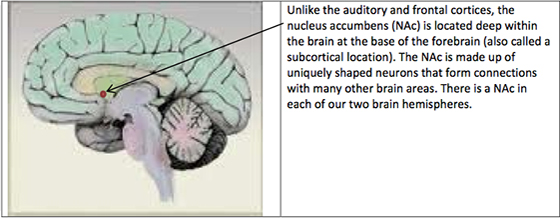
The NAc is a part of the mesolimbic reward system, discovered by McGill researchers in 1954. This �reward system is thought to be activated in a wide array of positive (eating, sex) and negative �(addiction) behaviors based on connections between different brain regions. Interestingly, more �abstract behaviors such as obtaining money also activate the mesolimbic pathway. When this pathway is �stimulated, the electric activity (or firing) of the associated neurons is markedly increased and the �neurotransmitter, dopamine, is released.�
The neuronal network between the NAc, the frontal and auditory cortices underlies the feeling of �pleasure we experience when we listen to our favorite music. There are a multitude of other networks �that involve the NAc. One well known pathway is thought to form the basis of addictions in some �individuals.�
Putting it all together: Using fPET to measure the dopamine release from neurons in a group of �volunteers, Drs. Zatorre and Salimpoor reported that, the more pleasurable a piece of music was to a �study volunteer, the greater the level of dopamine detected in the NAc of the mesolimbic pathway �described above. The researchers also found that the levels of dopamine in the NAc rose in anticipation �of listening to their favorite part of a piece of music. There was a correlation between level of pleasure �and the amount of neuronal activity detected not only in the NAc but also in neuronal connections �between the NAc and the auditory and frontal cortices.���
We�ve only just scratched the surface of this brilliant research. Hopefully, explaining some of �neurobiological jargon has helped you appreciate the research. Please leave your feedback and thoughts �on the Music Empowers Foundation Facebook page and let us know if there are any questions you have �on this research and whether there are other areas you�d like us to focus a future column on.� Enjoy �your summer! �
Reference:
- Zatorre RJ and Salimpoor VN (2013) From perception to pleasure: Music and its neural substrates. Proc �Natl Acad Sci USA 110:10430 10437.�
�